From Belém to Schools: Building Environmental Literacy in 2025
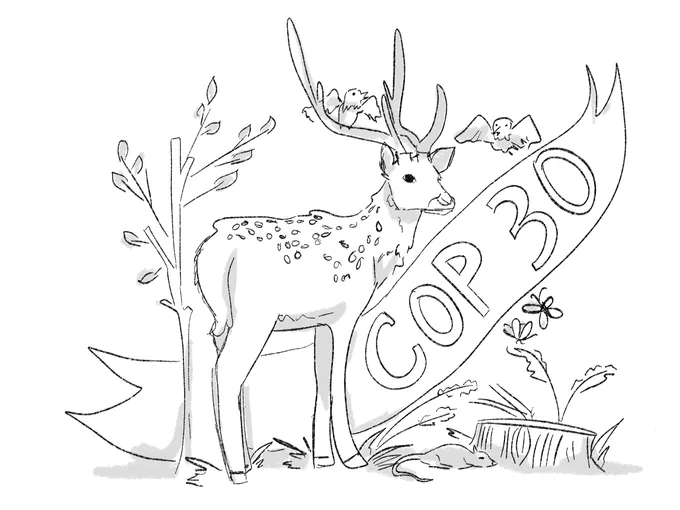
Students are often overlooked in their role as stakeholders in environmental advocacy. Similarly, thorough environmental education is discernibly overlooked in many school systems. Despite both remaining unrecognized, youth have taken the responsibility to influence climate change movements globally. Demonstrably, as young people have proved themselves capable of taking charge in such powerful activism, the possibilities of what they could achieve with structured environmental literacy are endless.
Out of 193 member states mandated by the United Nations [6] to submit their pledges to cut carbon emissions, only 64 have honoured this guarantee [4]. The 30th session of the annual Conference of the Parties (COP 30) will occur during November in Belém, Brazil, concentrating on tackling climate change, primarily by limiting the global temperature to 1.5°C and adjusting food systems to adapt to a higher threshold of temperature [3].
The significance of this summit in 2025, at least within the context of climate justice, cannot be overstated. As the President-designate explained, it is “urgent we address, in a comprehensive and synergetic manner, the interlinked global crises of climate change and biodiversity loss in the broader context of achieving the SDGs (Sustainable Development Goals).” [3] This “urgency” falls flat when over 100 000 mature rainforest trees have been chopped down to make traveling easier for the 70 000 political activists set to attend COP 30 [5]. Such dangerous contradictions never go unnoticed by youth activists, a glaring microcosm of why attempting to deliver global solutions without them stagnates progress.
It is a common pattern that high-level conferences such as COP 30 tend to create loopholes for the very climate negligence that they claim to prevent, while students are the first to stand on principles. Even without formal education, the response from youth when it comes to carbon-cutting and climate resilience has been staggering. On an institutional level, the most effective way to educate youth on the environment is through standard curriculums. On an individual level, the lack of this kind of education has not stopped them from impacting real climate change policies.
Youth-led movements often inaugurate climate change action. For instance, in allegiance with Fridays for Future (FFF), spearheaded by Swedish activist Greta Thunberg at age 15, students skip Friday classes to protest and demand action from political leaders on climate issues. The immense pressure FFF placed on governments to regard climate change not as a result of economic or foreign issues, but rather as being complicit in human rights violations, pushed 25 German cities to change their environmental policymaking processes [5]. Another of many examples, The Global Youth Biodiversity Network has been one of the key leaders in pushing the Global Biodiversity Framework, adopted during COP 15 to promote healthy nature and human relationships by 2050 [1].
The simplest method to harbour earnest commitment to climate advocacy begins from environmental literacy; understanding the symbiotic association between humans and ecological systems through real data and verifiable sources. Perhaps as global warming, rising sea levels, and the fossil fuel industry are issues of priority– although teaching climate change should certainly be implemented within academia– it has, impressively, motivated a surge of personal learning for our future leaders. What they have achieved simply through self-education and conviction would only evolve if institutions recognized the potential in their passion.
To consolidate, while it may be true that students should be provided with substantive resources to understand the bitter realities of climate change to be equipped with creating meaningful reform, history suggests it is not mutually exclusive. Thunberg has played a defining role for youth in climate politics. She explains, “This is all wrong. I shouldn’t be up here. I should be back in school on the other side of the ocean. Yet you all come to us young people for hope.” during a speech at the UN Climate Action Summit in 2019 [7]. It is counterintuitive to expect students to create change without something as fundamental as mainstream climate education.
Climate change is universal– it affects the poor, rich, young, and old. Climate education should consequently be universal, even if it exists without the grace of school curriculums. It is important to note that promoting implementation of environmental literacy within the curriculum is not to place responsibility on any demographic, especially not youth with limited resources in comparison to policy makers. Rather, it is to instill a climate-conscious mindset from an early age which requires both long-term and immediate action. As COP 30 comes to an end, it is urgent for more students to take it upon themselves to understand what these summits are working towards as relying on formal education is no longer feasible, and holds far too many risks to wait for. Youth-led movements and policy changes did not transpire from complacency; their starting point was curiosity, which developed into reform.
Works Cited
[1] Convention on Biological Diversity. “Kunming-Montreal Global Biodiversity Framework.” Convention on Biological Diversity, 18 Dec. 2023, www.cbd.int/gbf.
[2] Eckersley, Peter, et al. “Assessing the Impact of Fridays for Future on Climate Policy and Policymaking in German Cities.” Journal of Environmental Policy & Planning, vol. 27, no. 3, 17 Feb. 2025, pp. 1–13, https://doi.org/10.1080/1523908x.2025.2466821. Accessed 28 Feb. 2025.
[3] Hub, IISD’s SDG Knowledge. “Event: 2025 UN Climate Change Conference (UNFCCC COP 30) | SDG Knowledge Hub | IISD.” SDG Knowledge Hub, Oct. 2025, sdg.iisd.org/events/2025-un-climate-change-conference-unfccc-cop-30/.
[4] McGrath, Matt. “Climate Plans Don’t Limit Dangerous Warming, UN Says ahead of COP.” BBC, 28 Oct. 2025, www.bbc.com/news/articles/czdrv8m5v4lo.
[5] Morrison, Chris. “100,000 Amazon Trees Chopped down to Build Road for COP30 Climate Conference – the Daily Sceptic.” The Daily Sceptic, 16 Oct. 2025, dailysceptic.org/2025/10/16/100000-amazon-trees-chopped-down-to-build-road-for-cop30-climate-conference/. Accessed 6 Nov. 2025.
[6] Nations, United. “COP30 to Take Place 10-21 November 2025 in Belém, Brazil | United Nations.” United Nations, 2025, www.un.org/en/climatechange/cop30.
[7] NPR. “Transcript: Greta Thunberg’s Speech at the U.N. Climate Action Summit.” Npr.org, 23 Sept. 2019, www.npr.org/2019/09/23/763452863/transcript-greta-thunbergs-speech-at-the-u-n-climate-action-summit.