Behind The Curtain: How The TDSB’s Admissions Theatre Keeps Failing Students
Art by Sahana Sakthivel
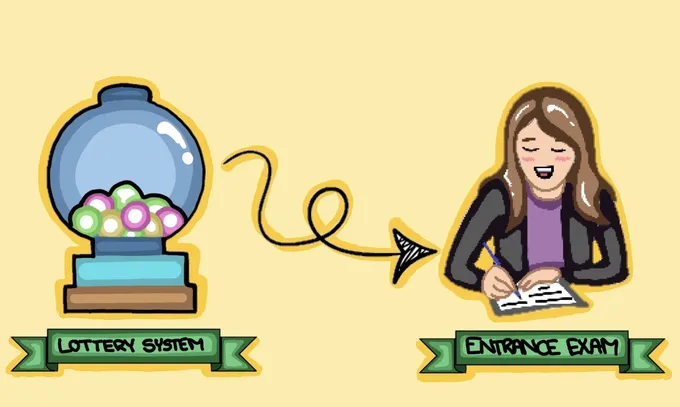
May 25, 2022: The Toronto District School Board has gotten rid of merit-based admissions for its specialized programs across Toronto [2]. All of them. It’s an enormous victory, trustees and other advocates argue, for equity in the city. Finally, students from communities marginalized over race and socioeconomic status would have fair access to coveted seats for arts, math, and science education that had long been dominated by wealthy, often white families.
This decision, sudden as it may have seemed, had been years in the making. A 2017 study from educational researchers at the University of Toronto found students in TDSB arts programs were 67% white compared to 29.3% across the board, and nearly twice as likely to come from high-income households [3]. Income inequality proved particularly troublesome, as the old merit-based system often demanded auditions, awards, and various extracurriculars. Margaret Greenberg, principal at John Polanyi Collegiate Institute, explained to The Globe and Mail that many students simply “did not apply in past years because they didn’t feel as confident … compared with someone who had built a portfolio” [1]. These were just some of the problems the lottery was expected to do away with.
But that didn’t quite happen. Three years and three cohorts of lottery-admitted students later, the TDSB has reversed course, returning to merit-based admissions for the 2026-27 cohort [4]. Defenders of the lottery may say it didn’t get a fair chance, that more time was needed. But truthfully, the lottery failed to achieve its stated goal of increasing diversity. It was a policy failure on its own terms.
I was part of the last group admitted to TOPS through essays and exams. Though I somewhat envied the students who could get into these programs through lotteries rather than the days of work I’d put in, I was hopeful the new system would open them up to more people and change them for the better. Statistics and testimonials alike say otherwise.
For one example, look at the music-theatre program at Etobicoke School of the Arts (ESA). Its head, Patricia Warnock, told the Toronto Star she “hasn’t seen much change” in diversity since the lottery was introduced. In fact, she witnessed what might be “the opposite,” with more students from the surrounding middle-class neighbourhood choosing ESA over other local schools, taking the place of students travelling across the city as was common before [6]. Warnock was clear about her support for increased equity and diversity. She simply found that the lottery didn’t deliver it.
The situation wasn’t much better for the TDSB’s top STEM offerings. In its fight against the lottery, nonprofit Save Our Schools brought on University of Toronto economist Marcin Pęski to look at demographic data from three programs, including TOPS at Marc Garneau. Though the lottery aimed to transform demographics through admissions, Pęski found that underrepresented students faced barriers mainly in their application rates, not admissions [5]. Simply randomizing selection after applications couldn’t address the deeper issues keeping these students from applying in the first place.
Applications to TDSB specialized programs did increase dramatically under the lottery, from about 1,400 to 2,300 for the arts, and from 3,000 to over 4,000 for math and science [1]. The board celebrated this “tremendous interest” as evidence of the lottery’s success. But increased applications mean little if the demographic makeup remains unchanged. And as seen at schools like Marc Garneau and ESA, random admissions don’t necessarily increase diversity in these programs or help underrepresented groups apply to get into them at higher rates.

My aim with this piece isn’t to attack students who’ve entered special programs through the lottery. I know many TOPS students admitted after me, through the lottery, who are thriving in the program. But when admissions standards slip, the education follows suit. I spoke to Harithra, a Grade 10 TOPS student, who described what came with the lottery: "The math, science and English courses for Grade 9s were exactly the same as the regular streamed courses, just with a bit of untested enrichment. That didn't prepare us for Grade 10 at all." The lottery was steadily diluting the program. And TOPS not only saw watered-down curriculums, but reduced club involvement and overall program spirit, all for an increase in diversity that never really appeared.
Harithra also critiqued a key component of the TDSB’s lottery: the expression of interest, explaining that: “If you said ‘I love math, science, technology and English,’ you were automatically qualified. Does that really tell you whether a student is interested in the program?” Of course not. The lottery had no good way to measure student interest. And that was its cruel irony. It not only hurt students that could have gotten into specialized programs on merit previously, but also students that did get in but wouldn’t thrive there. When students are put in environments they’re unprepared for, they’re not being done any favours. They’re simply being set up to struggle.
Yet even after all this, we can’t simply revert to the old merit-based system as it was. That system, and the environment around it, still carry the same flaws that prompted the lottery in the first place. I think Ray Fontaine, whose son was accepted to Rosedale Heights School of the Arts, best captured the contradiction with the old merit-based admissions: schools should be where “children are exposed to new passions and skills,” but requiring portfolios creates a prerequisite. “It’s almost like a chicken and egg situation” [4]. How can students demonstrate interest in something they’ve never had the chance to pursue?
Just implementing one system or the other doesn’t address the barriers that have made specialized programs unequal in the first place. Transit costs remain a “major barrier” for many families [6]. Elementary schools in many areas lack the arts and STEM programming that would prepare students to apply confidently. The TDSB has even banned schools like ESA from running “road shows” to visit schools in disadvantaged areas like Rexdale, actively preventing outreach that might have informed and encouraged more students on the idea of enriched education.
We do not need a return to the status quo, nor do we need to put blind faith in experiments like the lottery. What we actually need is to invest in elementary and middle school arts and STEM facilities. We need to cover transportation for families that can’t afford it. We need to help students develop their portfolios so that those who apply for specialized programs feel confident doing so. And, as the 2017 task force originally recommended, we need a more equitable distribution of resources across the TDSB, so that students and parents don’t feel so pressured to apply in the first place [3].
As the curtain falls on the lottery system, and the TDSB returns to merit-based admissions, we should recognize this isn’t an all-inclusive, all-happy ending. It’s just an intermission. We can keep arguing over how to have these programs better represent the student population. But until we address the deeper inequalities that decide who even dreams of applying to them, we won’t find that equity we so desperately seek. We’ll just be watching the same performance with a different cast, hoping for a better outcome we have no reason to expect.
Works Cited
[1] Alphonso, C. (2023, January 14). More TDSB students applied to specialized schools after admissions process overhaul. The Globe and Mail. https://www.theglobeandmail.com/canada/article-tdsb-specialized-school-programs/
[2] Draaisma, M., & Glover, C. (2022, May 26). TDSB votes to boost access to specialized schools, programs by changing admissions policy. CBC. https://www.cbc.ca/news/canada/toronto/toronto-district-school-board-specialized-schools-programs-admissions-1.6466071
[3] Gaztambide-Fernández, R., & Parekh, G. (2017). Market “choices” or structured pathways? How specialized arts education contributes to the reproduction of inequality. Education Policy Analysis Archives, 25, 41. https://doi.org/10.14507/epaa.25.2716
[4] Piercey, O. (2025, October 22). TDSB tosses lottery for specialty programs, brings back merit-based admissions. CBC. https://www.cbc.ca/news/canada/toronto/tdsb-scraps-lottery-merit-based-admissions-9.6949070
[5] Pęski, M. (2023, March 20). Evaluation of changes to the Student Interest Programs Policy. Save Our Schools. https://marcinpeski.github.io/files/TDSB.pdf
[6] Teotonio, I. (2025, October 26). Failed TDSB experiment or a fairer system? Two years in, lottery admissions for specialty schools divide students, educators. Toronto Star. https://www.thestar.com/news/gta/failed-tdsb-experiment-or-a-fairer-system-two-years-in-lottery-admissions-for-specialty-schools/article_48ab82c0-b3d1-47ee-8087-c74937de526c.html