Under the Radio Tower
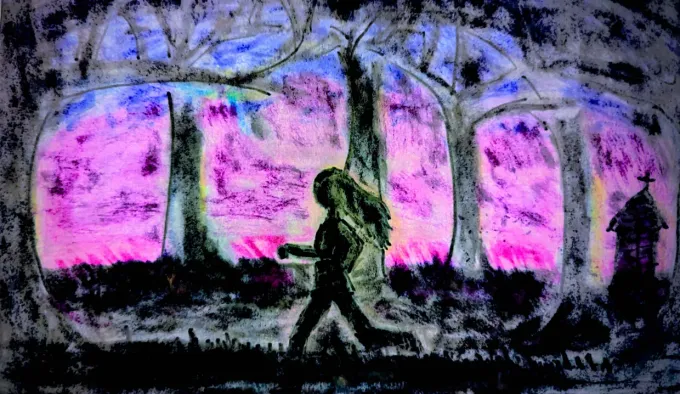
Art by Inaaya Ahmed
She was born in a church pew, where the air was thick with hymnals and heat. Her father was a preacher who believed suffering was the truest form of worship. Her mother played the organ softly, eyes shut tight, like she was trying not to exist. Their daughter sat between them every Sunday, quiet as a prayer, and learned early that love and fear were the same thing when spoken in the name of God.
Her name was Ethel. She grew up in a house where even the wallpaper looked tired of pretending to be holy. The walls knew everything — the shouting, the praying, the way her mother’s perfume mixed with candle smoke and grief.
She met Willoughby one summer under the radio tower. He was kind, a little reckless, with hands that shook when he laughed. He said her name like a secret. They spent their days in fields gone to gold, their nights in the backseat of his car, dreaming about running away. He told her he’d never leave. And she believed him, because she had to.
That summer, she wrote letters to her best friend Janie — pages filled with promises and fear and love she couldn’t name. Janie was the only one who ever really saw her. Holly Reddick lived down the road — beautiful, wild, everything Ethel wasn’t allowed to be. Holly kissed her once behind the church after choir practice, tasting like cherry soda and sin. They never spoke about it again.
Then the storm came. Willoughby disappeared — no note, no goodbye. Just the hum of the tower and the sound of thunder swallowing the fields. People said he left town but she didn’t believe them.
That’s when she met Logan. He was older, sharper around the edges. He promised her escape — real escape this time. They robbed a bank together, desperate and shaking, and when the sirens came, Logan didn’t make it out. She did. She ran until her legs gave out. She later found out he had been shot by a police officer.
For a while, she lived in motels and bus stations, sleeping beside men who didn’t ask her name. She told herself she was free, but she still felt the weight of the preacher’s cross pressing into her skin.
Then she met Isaiah. He told her she didn’t have to run anymore. She wanted to believe him — she always wanted to believe someone. His house was quiet. The fridge hummed. The rooms were clean in a way that felt unnatural. He made her dinner, poured her wine, asked her to sing. When she looked up, his eyes were full of something like love — or hunger.
After that, there was the needle. The sleep. The ache. She dreamed of home — of Janie and Holly laughing under the radio tower, of Willoughby’s hand in hers, of Logan’s voice saying, run.
Then came the dark. The freezer hums. The world goes still.
But death didn’t keep her. She lingers — in the wires, the wind, the static between stations. The preacher’s daughter, the runaway, the lover, the ghost.
And if you stand under the radio tower on a humid night, you can hear her voice behind the hum — soft, steady, still singing.